

Long tail vs short tail keywords is a constant confusion that every SEO specialist faces. Short-tail keywords bring reach and awareness, while long-tail keywords attract targeted, ready-to-convert traffic. This guide explains the difference, shows you how to use both strategically, and introduces future-proof strategies like AI-assisted discovery.

Why Keywords Still Matter in an AI Era
With AI search, answer engines, and voice queries dominating headlines, it is tempting to think keywords have lost their power. However, the truth is that keywords remain the foundation of digital discovery. Search intent continues to govern visibility, whether it is typed, spoken, or accessed through a visual interface.
In 2025, keywords are not just about ranking but about appearing in AI summaries, voice snippets, and visual searches. That is why the challenge is no longer finding keywords; it is choosing the right mix and aligning them with user journeys. In this blog, we explore how to navigate long-tail vs. short-tail keywords and use them as building blocks for stronger brand awareness and conversions.
What Are Short-Tail and Long-Tail Keywords?
Short-tail keywords are usually one to two words, broad, and high-volume. For example, “dress” or “digital marketing.” They face massive competition and low conversion intent, yet greatly help with brand exposure. On the other hand, Long-tail keywords are three words or more, such as “best dresses for a date” or “best digital marketing agency in India.” They have a lower search volume but a higher conversion intent.
Image (side-by-side short tail and long tail keyword)
Why Both Matter: Volume, Intent, and Business Potential
Focusing only on one type of keyword creates blind spots. Short-tail keywords generate visibility and awareness, making them perfect for brand positioning. But they are highly competitive. Long-tail keywords, on the other hand, tap into specific user needs.
According to Semetrical, long-tail keyword searches have a 3-5% higher click-through rate!
For example, ranking for “digital marketing” might bring 100,000 visitors with a 0.5% conversion, while “best digital marketing agency for small businesses” might bring 1,000 visitors with a 10% conversion rate. One builds visibility, the other drives revenue. The winning formula is a mix that balances awareness with action.
Comparison, Pros vs Cons, and When to Use Each
When it comes to long tail vs short tail keywords, it’s not just about search volume or competition; it’s about understanding how they serve different roles in your SEO ecosystem. Here’s a deeper breakdown:
| Factor | Short-Tail Keywords | Long-Tail Keywords |
| Search Volume | Sky-high; “coffee” can have 1M+ monthly searches. | Lower individually, but collectively can make up to 70%+ of all queries. |
| Competition | Brutal; Heavily dominated by big brands with high domain authority. | Easier to penetrate; smaller sites can win here. |
| CTR | Lower, since users may see multiple irrelevant results. | Higher, as results align closely with user intent. |
| Conversion | Weak, broad intent means fewer buyers. | Strong users searching “buy Red heels online” are ready to purchase. |
| Time to Rank | Long; can take 6–12 months (or more). | Faster; some long-tail terms rank within weeks if optimised well. |
| Best Use Case | Awareness campaigns, pillar pages, broad branding. | Mid-funnel and bottom-funnel content, FAQs, product/service pages. |
Pros and Cons
| Short-Tail Keywords | Long-Tail Keywords |
| Pros | Pros |
| Great for building brand awareness. | Capture high-intent searchers closer to conversion. |
| Help establish topical authority at scale. | Easier to rank with less authority. |
| Anchor content clusters (example: “digital marketing”). | Great for hyperlocal and niche businesses. |
| Cons | Cons |
| Extremely competitive. Ranking often requires high domain authority | Lower volume can make them seem “unattractive” to beginners. |
| Expensive in PPC campaigns. | Requires more content to capture enough reach. |
| Conversion rates are usually low. | Risk of keyword cannibalisation if not structured well. |
When Should You Use Each?
- Startups & Small Businesses: Focus on long-tail. They deliver quicker wins and conversions without burning budget on impossible-to-rank short-tail terms. Example: “affordable yoga mats in Chennai.”
- Mid-Sized Brands: Use a hybrid strategy. Rank for authority-driven short-tail like “yoga mats” while building conversions through long-tail like “best eco-friendly yoga mats for beginners.”
- Enterprises: With high domain authority, go after short-tail terms aggressively. But don’t abandon long-tail; they still capture voice search and niche customers.
Searcher Intent Mapping: Converting Intent Into Content
Keywords mean nothing without intent. Ranking for “laptops” doesn’t help much if the user is just browsing, while ranking for “best laptops for engineering students 2025” can directly drive conversions. The magic lies in aligning keyword types with the right content format.
Short-Tail Keywords – Pillar Pages & Categories
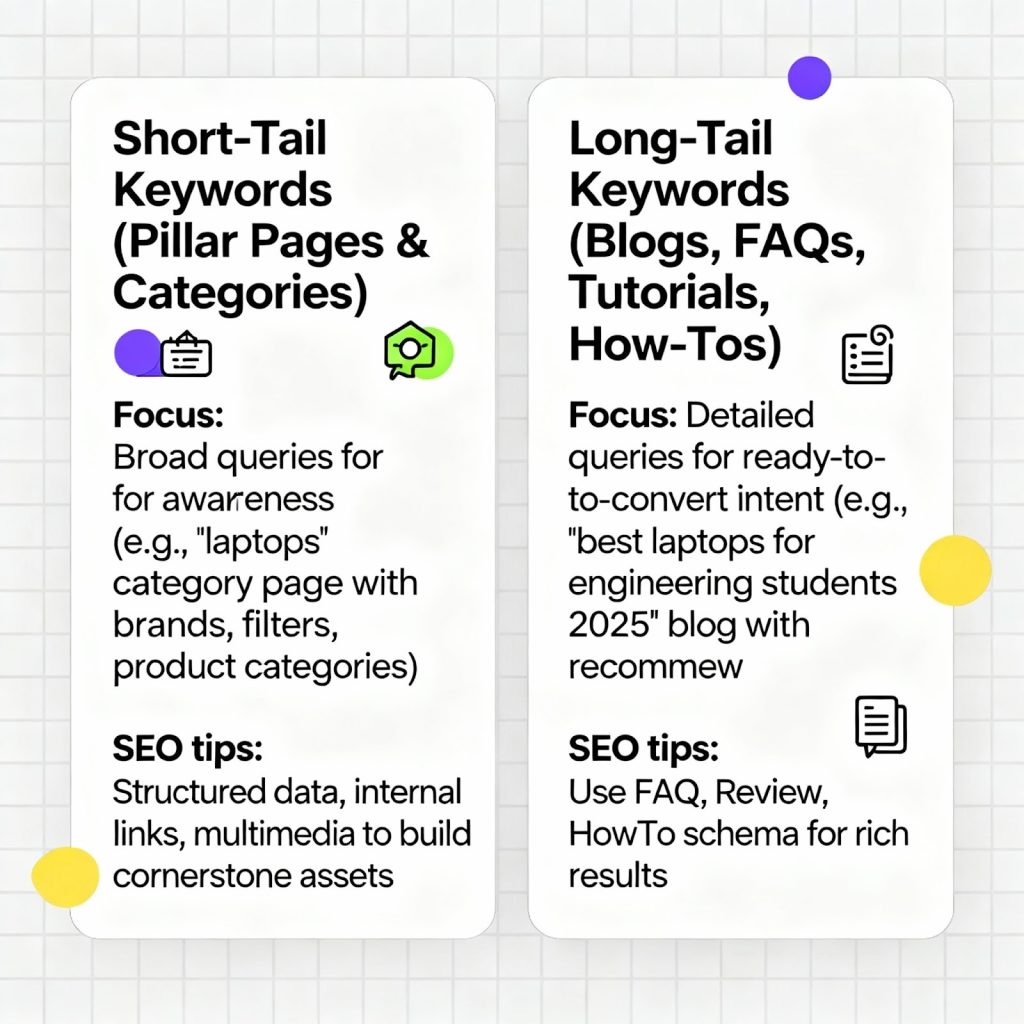
These focus on broad queries, ensuring to capture awareness. Think of them as digital billboards.
Example: “laptops” – A category page with major brands, filters, and product categories.
For SEO: Optimise these pages with structured data, internal links, and multimedia to make them cornerstone assets.
Long-Tail Keywords – Blogs, FAQs, Tutorials, How-Tos
These focus on detailed queries to capture the ready-to-convert intent.
Example: “best laptops for engineering students 2025” – A blog with recommendations, specs, and student discounts.
For SEO: Add schema (FAQ, Review, HowTo) to increase visibility in rich results.
Industry-Specific Intent Mapping
E-commerce: Long-tail keywords with modifiers close sales.
“Nike running shoes under ₹5000 for women” – Product page with price filters and reviews.
SaaS: “How-to” content nurtures leads and trial users.
“How to integrate CRM with Slack” – Step-by-step blog with screenshots and CTAs.
Local Businesses: Geo-modified queries help build trust and increase foot traffic.
“Dentist near me open Sundays” – Optimised GMB profile and location-specific landing page.
| Pro Tip: Use a content intent map, list your core keywords, assign them to funnel stages (TOFU, MOFU, BOFU), and match them with specific content types. |
Tools and Workflows to Find Both Types
Finding the right keywords isn’t about luck or secret formulas—it’s about pairing the right tools with smart filters and then mapping them to intent. Here’s a breakdown of how to go beyond the basics:
1. Ahrefs Keywords Explorer (or SEMrush) – Filter Like a Pro
Don’t just grab high-volume terms. Instead:
- Set Keyword Difficulty (KD) < 20 – Easier to rank for.
- Look for Volume < 500 – These are often ignored by big competitors but drive highly qualified traffic.
- Layer with “Include” filters – e.g., add modifiers like “best,” “near me,” “for beginners.”
2. Google Search Console (GSC) – Unearth Hidden Gems
- Head to Performance > Queries.
- Sort by Impressions, but low CTR, and you’re already showing up, but the title/meta isn’t compelling enough.
- Sort by Clicks, but average position > 10 – These are your low-hanging fruit keywords.
Tip: Add FAQs or refresh content targeting these terms, and you’ll often jump 3–5 positions.
3. Google Autocomplete & Related Searches – Intent From the Source
- Start typing a short-tail keyword (e.g., “best running shoes”).
- Take a look at the recommendations (“best running shoes under 5000,” “best running shoes for flat feet”).
- Scroll to the bottom of SERP for “Related Searches”
Hack: Use the wildcard method: type “best __ shoes for running” and Google fills in with unexpected long-tail gems.
4. AnswerThePublic – Turn Curiosity Into Content
- Great for question-based queries: “Why are running shoes expensive?”
- Organise results into categories (Who, What, Why, How).
- Perfect for building FAQ-rich blogs or snippets.
5. ChatGPT (with Validation) – Creativity Meets Data
- Use AI to generate variations around your seed keyword.
Example: Seed = “laptop for students” – ChatGPT outputs: “budget laptop for college students,” “lightweight laptop for travellers,” “best laptops under 50k for engineering.” - Then, run these through Ahrefs/SEMrush for data validation.
Hack: Ask AI to cluster keywords by intent (informational vs transactional); it will save hours of manual grouping.
6. Bonus: Reddit, Quora & Forums – Real Conversations = Long-Tail Ideas
- Search threads where real users vent, ask, or compare.
Example: On Reddit, someone asks: “Which affordable laptop is best for coding?” – That is a purchase-intent long-tail keyword.
Four High-Impact Strategies That Actually Work
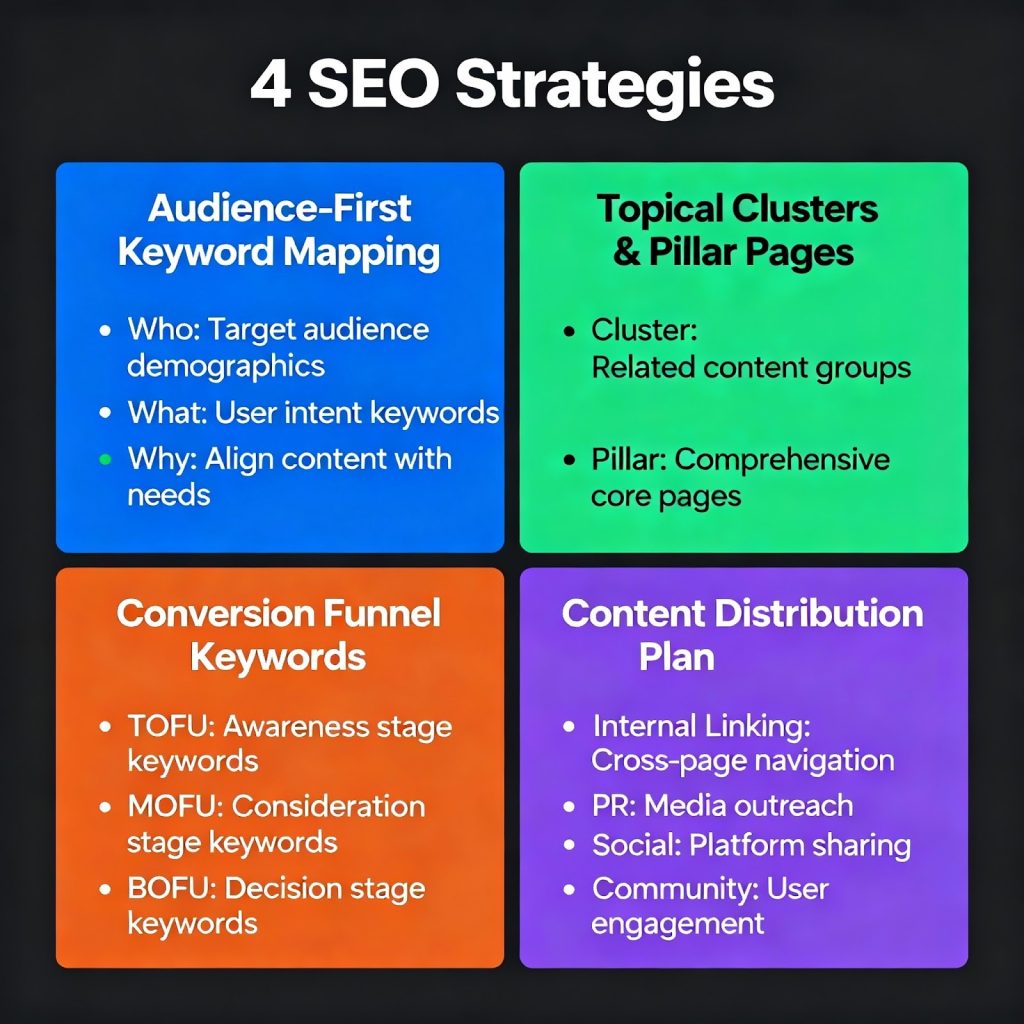
1. Audience-First Keyword Mapping (The Three W’s: Who, What, Why)
Google supports people-first content. So, your attempt to make search engine-first or AI-first content will highly fail if it doesn’t please the readers. So, for it to focus on the 3 W’s,
- Who are you targeting? ( A first-time buyer, an enterprise CTO, a small business owner)
- What are they searching for? ( Product comparisons, solutions to pain points, cost breakdowns)
- Why are they searching? ( Research, decision-making, or ready-to-buy)
By aligning keyword research with these three W’s, you stop chasing vanity metrics and start creating content that actually converts and works.
2. Topical Clusters and Pillar Pages
Google doesn’t reward random content; it rewards authority.
Short-tail keywords become your pillar pages (broad, comprehensive guides), and Long-tail keywords are the cluster pages (deep dives into subtopics). Interlink them so this signals to Google that you own the topic.
For Example, you can look at our title here, the title consists of both short-tail and long-tail keywords. Here, the
- Pillar = “Long Tail vs Short Tail Keywords.”
- Cluster = “Is It Better to Use Long Tail or Short Tail Keywords for SEO?”
3. Conversion Funnel Optimisation with Keywords
Not all keywords serve the same purpose; some guide users through your funnel:
- TOFU (Top-of-Funnel) → Informational short-tails: “What is CRM?”
- MOFU (Middle-of-Funnel) → Long-tails showing comparison: “HubSpot vs Zoho CRM.”
- BOFU (Bottom-of-Funnel) → Long-tails with buying intent: “buy CRM software for small business.”
4. Link and Distribution Plan
Publishing content without promotion is like opening a shop in the desert. You need a distribution and a plan that works well. You can use,
- Internal linking: Spreads authority across your site.
- PR & Guest Posts: Boosts domain authority and referral traffic.
- Social + Email: Drives initial clicks (CTR boosts rankings indirectly).
- Community distribution: Share on Quora, Reddit, and LinkedIn groups where your target audience is active.
| Pro Tip: For every new long-tail article, create 3–4 internal links from older posts. This accelerates indexation and improves ranking velocity. |
AI-Assisted Long-Tail Discovery and AEO Optimisation
AI isn’t killing keyword research; it’s supercharging it invariably. Here are tips, tricks and steps for you to use.
Step 1: Generate
Use AI to create search intent trees.
- Prompt: “List 50 questions a first-time car buyer might type into Google before purchasing.”
- Output: “best cars for beginners under 10 lakhs,” “cars with lowest insurance cost,” etc.
Step 2: Validate
Run AI-generated ideas through Ahrefs/SEMrush. Filter by:
- Volume > 50 (not dead).
- KD < 20 (low difficulty).
- CPC > $1 (shows commercial intent).
Step 3: Optimise for AEO (AI Answer Engines)
AI Overviews (like Google’s SGE or Bing Copilot) prefer direct, structured answers.
- Write concise lead paragraphs (40–60 words).
- Add FAQ schema.
- Use tables and bullet points (easier for AI to extract).
Step 4: The Validation Loop
- Generate ideas with AI.
- Validate with SEO tools.
- Publish snippet-ready content.
- Track impressions, CTR, and featured snippet wins in GSC.
This cycle ensures you’re not only ranking on Google but also appearing in AI answers, voice assistants, and multimodal search (text, image, and voice).
Common Pitfalls and How to Avoid Them
- Over-optimising long-tail variants: Leads to keyword stuffing.
- Cannibalisation: Targeting the same keyword across multiple pages confuses Google.
- Chasing only volume: High traffic, low conversions.
- Ignoring structured data: Missed snippet and AI overview opportunities.
Winding Up
So, which one is better? Long tail vs. short tail keywords? The truth is neither. Long-term and short-term keywords don’t work separately; they work together. Short-tails build visibility, long-tails drive conversions. AI and AEO are changing the game, but with the right strategy, you’re not just ranking, you’re owning your niche in both search engines and AI results.
FAQs
1. Are long-tail keywords always better for small businesses?
Yes, small businesses often benefit more from long-tail keywords because they target specific needs with lower competition. This makes them easier to rank for and more likely to drive high-quality leads.
2. How do I avoid keyword cannibalisation?
Cannibalisation happens when multiple pages compete for the same keyword. The fix is to assign each keyword to a single, well-structured page, then interlink supporting content. Use tools like Search Console to identify cannibalisation and consolidate duplicate content into stronger, authoritative pages.
3. How to prioritise low-volume but high-intent keywords?
Always weigh traffic against conversion potential. Low-volume long-tail keywords often attract ready-to-buy users, making them valuable. Prioritise these when resources are limited, and complement them with medium-volume terms for balanced growth. Track conversion rates to justify their importance beyond traffic numbers.
4. Do short-tail keywords still matter in 2025?
Yes, short-tail keywords remain essential for brand awareness. They serve as “pillars” that anchor topical clusters and attract broad audiences. While they are hard to rank for, they provide visibility and credibility, which is crucial for long-term authority building and enterprise-level brands.
5. Can AI help discover new long-tail keywords?
Definitely, AI tools like ChatGPT can generate question-based queries that reflect natural user searches. Combine this with keyword validation in tools like Ahrefs or Semrush to analyse the traffic.
6. What is the ideal balance of long-tail vs short-tail keywords?
A typical split could be 70% long-tail and 30% short-tail. This ensures steady conversions while also building long-term authority.
7. How do voice searches affect keyword strategy?
Voice searches are naturally long-tail and conversational in nature. Optimising with FAQ-style content and schema markup makes your site voice-search friendly. Including phrases like “near me” or “best for” aligns with how users speak queries into assistants like Siri or Alexa.
8. Which industries benefit most from long-tail keywords?
Niche industries, such as SaaS, healthcare, e-commerce, and local services,es thrive with long-tail keywords. Users in these areas search with high intent, often specifying conditions, locations, or comparisons. Long-tail optimisation helps capture these valuable segments cost-effectively.
9. Do long-tail keywords impact paid search too?
Yes. In PPC campaigns, long-tail keywords reduce cost-per-click while improving ad relevance. This improves Quality Score and ROI. Many advertisers ignore them, so targeting long-tail in ads can give you a cost-effective competitive edge.
10. How frequently should my keyword strategy be updated?
Review your keyword portfolio quarterly. Search trends, competitor strategies, and algorithm changes evolve fast. Regular updates allow you to retire underperforming keywords, double down on winners, and explore emerging long-tail opportunities shaped by seasonal or cultural trends.
