

A data-backed comparison from the team at echoVME Digital, with real campaigns and real failures
Macro influencers are ideal for building rapid brand awareness and large-scale reach, while micro influencers excel at driving trust, engagement, conversions, and better cost efficiency.
The most successful influencer marketing campaigns rarely rely on a single creator tier. Instead, they combine the broad visibility of macro influencers with the stronger ROI and authenticity of micro influencers.
Macro Influencers
100K–1M+ followers
3–5× ROI
1–3% Engagement
Best for fast reach, brand awareness, and product launches.
Micro Influencers
10K–100K followers
5–8× ROI
3–8% Engagement
Best for conversions, trust, community building, and cost-efficient campaigns.
We get this question in almost every influencer marketing pitch: should the budget go toward one big-name macro influencer, or a bench of smaller micro-influencers? We’ve run both through our influencer division, BuzzFame, across categories from jewellery to D2C beauty, and the honest answer is that the two tiers aren’t really competing for the same job. This guide breaks down the actual ROI data behind each tier, when each one wins, and real case studies, including one expensive lesson in why bigger isn’t automatically better.
Macro vs Micro Influencers: Quick Definitions
A macro influencer is a creator with roughly 100,000 to 1 million (or more) followers, offering a brand fast, broad reach and a more polished, professionally produced content style.
A micro-influencer is a creator with roughly 10,000 to 100,000 followers, offering a smaller but far more engaged, niche-specific audience and a more native, authentic content style.
The distinction matters because it shapes everything downstream: cost, content style, measurement, and, most importantly, what kind of ROI each tier is actually built to deliver.
The ROI Data: What the Numbers Actually Say
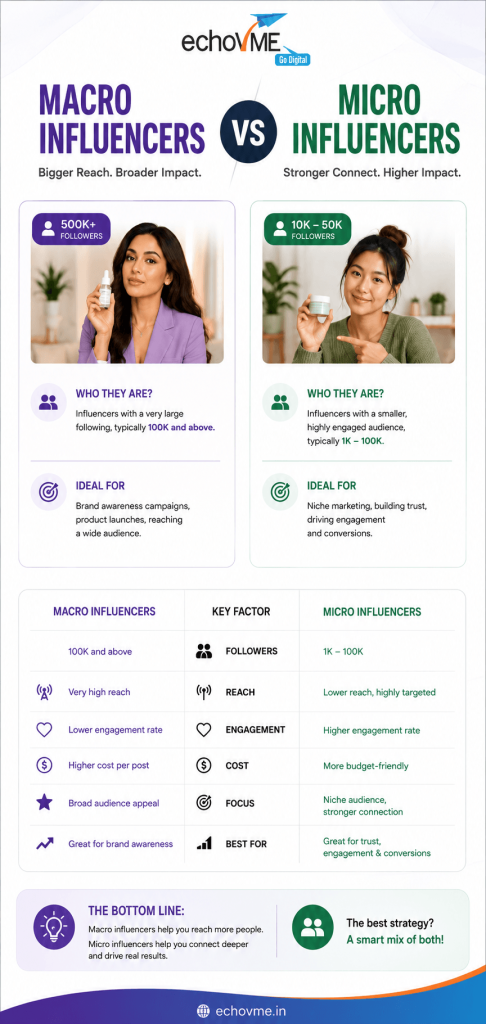
| Factor | Macro Influencer | Micro Influencer |
| Follower range | 100K – 1M+ | 10K – 100K |
| Typical engagement rate | 1-3% | 3-8% |
| Typical ROI | 3-5x return | 5-8x return |
| India cost per post | ₹50,000 – ₹8L+ | ₹8,000 – ₹80,000 |
| Best objective | Fast, broad awareness | Conversion, trust, community |
| Content style | Polished, brand-produced feel | Authentic, native, spontaneous |
| Risk profile | Higher (reputation, one point of failure) | Lower (diversified across many creators) |
The pattern across nearly every 2026 industry benchmark is consistent: macro influencers typically return 3-5x on spend, largely by generating fast, wide awareness, while micro influencers typically return 5-8x, driven by stronger engagement and significantly lower per-post costs.
Neither number tells the whole story on its own, a macro influencer’s 3-5x return on a much larger spend can still produce more total revenue than a micro campaign’s higher ROI on a smaller budget.
The right comparison isn’t ROI percentage in isolation, but ROI against the specific objective the campaign was built for.
When Macro Influencers Win
1. You need fast, broad awareness
A single well-placed macro influencer can put a new product in front of a large audience in days, which is difficult to replicate quickly with a bench of smaller creators.
2. You’re entering a new market
Entering a new city or country often calls for a recognisable local name to establish credibility quickly, before a longer-term micro-influencer community strategy can take root.
3. You want cultural or category legitimacy
A large, well-known creator lending their name to a product can function similarly to a celebrity endorsement, signalling scale and legitimacy to a broad audience.
4. You need reusable, polished creative
Macro influencers typically produce higher-quality, more polished content, which can double as reusable brand assets across paid ads and other channels.
When Micro Influencers Win
1. You need conversions, not just visibility
Micro-influencer audiences convert at a noticeably higher rate because the recommendation feels personal rather than broadcast.
2. Your category depends on niche trust
Beauty, fitness, finance, and other high-consideration categories benefit from creators whose followers trust their specific expertise, not just their fame.
3. You want to test before scaling spend
With lower per-post costs, brands can test creative, offers, and audiences across a bench of micro-influencers before committing a large budget to a single approach.
4. You want to reduce single-point-of-failure risk
A bench of 15-20 micro-influencers spreads risk; if two or three underperform or worse, become a PR liability the campaign as a whole survives.
Real Examples and Case Studies
Case Study 1: Fyre Festival – The Macro-Influencer Cautionary Tale

Fyre Festival remains one of the most widely cited examples of what massive macro and celebrity-tier reach cannot fix. The 2017 event was promoted through a coordinated wave of top-tier models and celebrities, including a single Kendall Jenner Instagram post reported to have been paid roughly $250,000, reaching millions of followers in one post.
The reach was enormous and the awareness was real, ticket sales sold out within days. But the event itself collapsed almost immediately, because massive audience reach was never the bottleneck; delivery and trust were.
The lesson we take from Fyre: macro and celebrity reach can create demand at incredible speed, but reach alone cannot substitute for a trustworthy product behind it, and when a macro campaign goes wrong, it goes wrong publicly and expensively.
Case Study 2: Gymshark – Scaling Through an Athlete and Influencer Bench

UK fitness apparel brand Gymshark built much of its early growth by working with fitness YouTubers and Instagram creators rather than traditional celebrity endorsements, later formalising this into a structured athlete and influencer ambassador program spanning multiple tiers.
Rather than betting on one or two macro names, the brand built an ongoing bench of creators genuinely embedded in the fitness community, which helped it grow from a UK garage startup into a billion-dollar apparel company.
The lesson: even brands that eventually work with larger creators tend to do it as an extension of a broader, community-rooted influencer bench, not as a replacement for one.
Case Study 3: Mamaearth – Micro First, Macro Later

As we covered in our micro-influencer guide, Mamaearth built its early trust with beauty experts and parenting micro-influencers rather than celebrities. Once the brand had scaled significantly, it layered in mainstream celebrity and macro-tier campaigns, including television commercials and Bollywood collaborations, for a pure mass-awareness push.
This sequencing is instructive: Mamaearth used micro-influencers to build the credibility a new brand needs, then used macro reach once that credibility already existed to accelerate growth further, rather than trying to buy trust with reach from day one.
Case Study 4: What We Tested at echoVME
We did this comparison directly for a D2C beauty client at echoVME. Rather than assuming which tier would work better, our BuzzFame team ran a small pilot: a portion of the budget went to a single macro influencer in the beauty space, and the rest was spread across a bench of relevant micro-influencers, each with a unique trackable code.
The macro placement generated the largest single spike in reach and follower growth within 48 hours. But when we pulled the numbers a few weeks later, the micro-influencer bench had driven a noticeably higher volume of code-attributed purchases relative to spend.
Our takeaway for the client, and the one we now give most brands: use the macro placement to open the door, and the micro bench to walk people through it.
How We at echoVME Decide Between Macro and Micro
- We start with the funnel stage. A brand-new launch or market entry usually leans macro for initial visibility; an established brand looking to convert an already-aware audience usually leans micro.
- We look at budget size and risk tolerance. If the budget can only support one or two placements, we lean macro for guaranteed reach; if it can support a bench of ten or more, we lean micro for compounding, trackable ROI.
- We factor in category and consideration level. High-consideration categories beauty, finance, wellness usually convert better through micro-influencer trust; broad, low-consideration categories can convert well through macro-driven awareness alone.
- We vet risk more heavily at the macro tier. A macro influencer’s history and past brand associations get more scrutiny, since a single misstep with one large creator carries outsized reputational risk compared to one underperforming creator in a diversified micro bench.
The Hybrid Approach: Best of Both
In practice, we rarely recommend an either-or decision to clients. The structure we default to for most mid-sized D2C and lifestyle brands is a tiered blend: one or two macro placements to generate an initial wave of reach and social proof, layered with a larger bench of micro-influencers to convert that awareness into trackable, cost-efficient sales.
This mirrors the pattern we’ve seen across nearly every real-world case study in this guide brands that started with credibility-building micro-tier work and added macro reach later tend to outperform brands that tried to buy both trust and reach from a single big name.
Common Mistakes When Choosing a Tier
- A macro influencer’s large audience means little if that audience isn’t genuinely interested in the product category.
- Ignoring past controversies or brand affiliations of a macro influencer, which can turn into a costly crisis if it surfaces mid-campaign.
- Betting an entire budget on a single macro placement instead of spreading spend to reduce risk and enable testing.
- Expecting a micro-influencer bench to deliver overnight mass-market awareness, which isn’t the job this tier is built for.
- Comparing raw ROI percentages across tiers without accounting for the very different budget sizes and objectives behind them.
This tiered, data-first approach is how echoVME has operated since it began. Sorav Jain, our Founder & CEO, has spent 18+ years in digital marketing, growing echoVME from a Chennai-based startup in 2011 into a 150+ member agency serving 300+ brands, while also founding Digital Scholar, India’s agency-style digital marketing training institute.
Under his guidance, our BuzzFame division has run 300+ influencer campaigns across every tier from nano to celebrity, and the comparisons in this guide reflect patterns we’ve tested directly with client budgets, not assumptions borrowed from a generic playbook.
A Simple Budget Allocation Framework
Clients often ask us for a starting split rather than an abstract principle, so here’s the rough allocation we typically propose before adjusting for category and objective:
- Early-stage or new brand: Roughly 60-70% of budget goes to a bench of 10-20 micro-influencers, since this tier does the heavy lifting on conversion and cost-efficient reach at this stage.
- Growth-stage brand with existing awareness: A more even split, often 50-50, using one or two macro placements to re-ignite awareness while a steady micro-influencer bench sustains conversions.
- Established brand entering a new category or market: A larger share, often 50-60%, goes toward macro or mega placements to secure category leadership and cultural relevance, with a smaller always-on micro bench maintaining engagement between major moments.
These are starting points, not fixed rules, we adjust based on category economics, seasonality, and what a pilot phase shows us about actual conversion rates for that specific brand and audience.
Does the Platform Change the Answer?
The macro-versus-micro calculus also shifts by platform, and it’s worth accounting for before locking a budget split.
- Instagram: Reels-driven micro-influencer content tends to convert well for D2C and lifestyle categories, while macro placements still carry a strong feed-visibility advantage for pure awareness pushes.
- YouTube: Micro and nano creators on YouTube often build unusually loyal, high-intent subscriber bases for long-form reviews, while macro YouTubers deliver reach comparable to a mid-size TV spot for category-defining launches.
- LinkedIn: Macro and celebrity creators remain the default for building instant category credibility in professional and B2B contexts, since scale and title still carry outsized weight on this platform.
Our general advice: don’t pick a tier in isolation from the platform it will run on; the same creator size can behave very differently depending on where the content lives.
Conclusion
The macro-versus-micro decision is not about picking the “better” influencer tier in isolation. It is about matching the right kind of reach to the result the campaign needs to deliver. Macro influencers can create fast visibility, cultural relevance, and a strong initial spike in attention, while micro-influencers bring the audience trust, engagement, and conversion efficiency needed to turn that attention into action.
For many brands, the strongest campaigns combine both: macro placements to create momentum and a carefully selected micro bench to sustain interest and drive measurable results. The right balance depends on your brand stage, category, budget, platform, and risk appetite.
Trying to work out the right macro-micro mix for your next campaign? That’s a strategy conversation our BuzzFame team has with clients every week. Get in touch with us at echoVME to build a plan calibrated to your budget and goals.
FAQs Related To Macro vs Micro Influencers
What’s the main difference between macro and micro influencers?
Macro influencers have roughly 100,000 to 1 million+ followers and deliver fast, broad reach. Micro influencers have roughly 10,000 to 100,000 followers and deliver stronger engagement and conversion at a lower cost.
Which tier delivers better ROI overall?
Micro influencers typically deliver higher ROI (5-8x) than macro influencers (3-5x), largely due to lower costs and stronger engagement, though macro campaigns can generate more total revenue on larger budgets.
Are macro influencers worth the higher cost?
Yes, for the right objective. Macro influencers are worth the cost when the goal is fast, broad awareness or market entry but they’re a poor fit if the goal is cost-efficient, trackable conversions.
How much do macro influencers charge in India?
Indian macro and mid-tier influencers typically charge ₹50,000 to ₹8 lakh or more per deliverable in 2026, depending on follower count, category, and usage rights, compared to ₹8,000-₹80,000 for micro creators.
Can a brand use both macro and micro influencers together?
Yes, and we recommend it for most mid-sized brands. A common structure uses macro placements for initial reach and a micro-influencer bench to convert that awareness into trackable, cost-efficient sales.
What is the biggest risk of working with macro influencers?
Concentrated reputational risk. A single macro influencer’s controversy or past behaviour surfacing mid-campaign can derail the entire budget, unlike a diversified bench of micro-influencers.
Which tier is better for a new brand launch?
It depends on the goal: macro influencers help a launch get noticed quickly, while micro-influencers help a new brand build the trust needed to convert that attention into actual customers.
How do you measure ROI differently for each tier?
Macro campaigns are usually measured on reach, impressions, and brand lift; micro campaigns are measured more precisely through trackable codes, links, and direct attributed conversions per creator.
Is a mega-influencer the same as a macro influencer?
Not quite. Macro influencers generally have 100,000 to 1 million followers, while mega-influencers and celebrities exceed 1 million, typically commanding even higher fees for mass-market awareness.
How does echoVME decide which tier to recommend a client?
We assess funnel stage, budget size, category, and risk tolerance. New launches often lean macro for visibility; established brands seeking conversions often lean micro for trackable ROI.
