

There isn’t a single marketing strategy that works for every business. Understanding when to use influencer marketing, affiliate marketing, or a combination of both is what sets successful brands apart. It’s an approach followed by BuzzFame, one of the best influencer marketing agencies in India, when planning campaigns for businesses across industries.
A head-to-head comparison from the team at echoVME Digital, based on campaigns we’ve actually run.
Quick Summary
Influencer Marketing vs Affiliate Marketing
Influencer Marketing
- Builds brand awareness
- Creates audience trust
- Ideal for product launches
- Focuses on reach & engagement
Affiliate Marketing
- Performance-based model
- Commission only after sales
- Easy ROI tracking
- Ideal for conversions
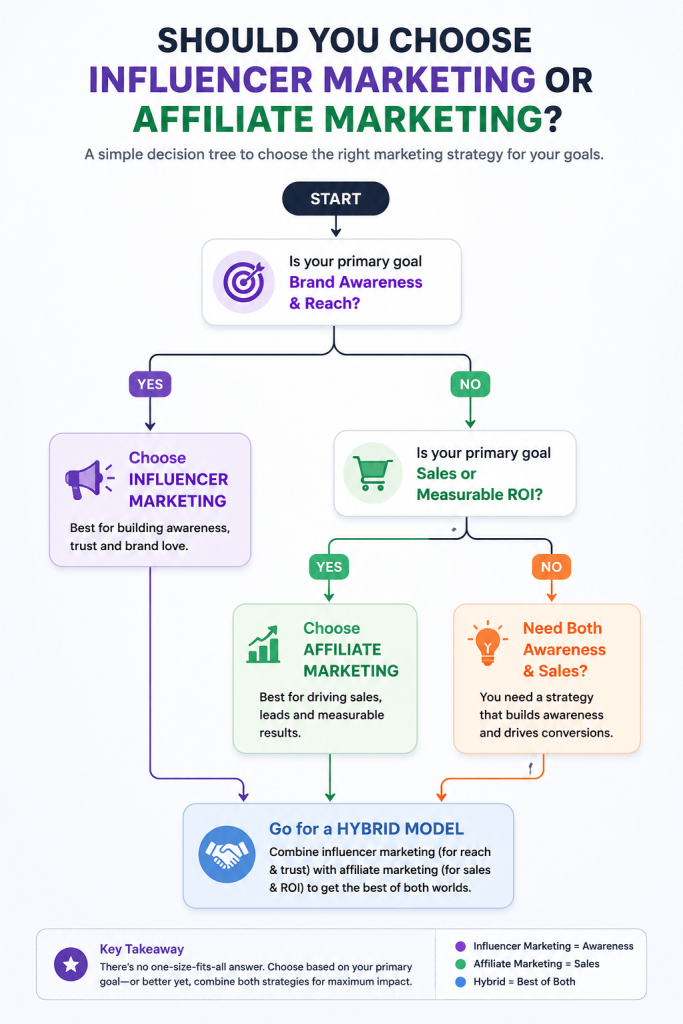
Neither model is universally better in 2026. Influencer marketing excels at building brand awareness and trust, while affiliate marketing delivers measurable, pay-for-performance ROI. Our experience shows the strongest results come from combining both strategies instead of choosing one over the other.
We at echoVME get asked this question in almost every strategy call: should our budget go into influencer marketing or affiliate marketing? It’s a fair question, and it doesn’t have a one-line answer.
We’ve run both models for clients across industries through our influencer division, BuzzFame, and through the performance marketing engagements we manage directly for clients.
This blog is our honest, experience-based comparison of the two, what each one actually does, where each one wins, and how we decide which one (or which combination) to recommend to a client.
What Is Influencer Marketing?
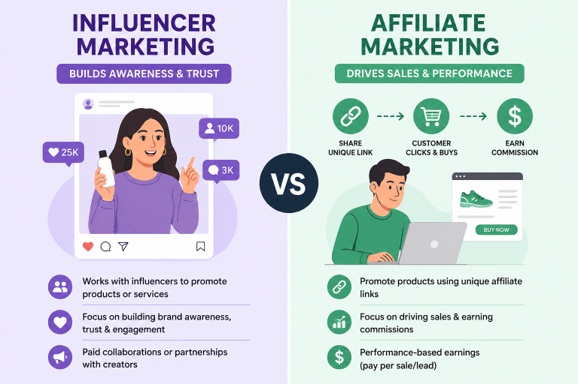
Influencer marketing is a paid or barter-based collaboration between a brand and a social media creator, where the creator promotes a product or service to their audience using their own content style and voice.
The value exchange is trust; the creator lends the brand a slice of the credibility they’ve built with their followers. Payment is typically a flat fee, a product barter, or increasingly, a hybrid of a base fee plus a performance bonus.
What Is Affiliate Marketing?
Affiliate marketing is a performance-based model in which a brand pays a publisher, creator, or website a commission only when their unique link, code, or referral leads to an actual sale or qualifying action.
There’s no upfront fee in a pure affiliate arrangement; the affiliate takes on the effort of driving traffic, and the brand pays only for results.
In India, affiliate marketing has grown from an estimated $331 million market in 2023 to a projected $465 million in 2026, now accounting for roughly 10-12% of digital marketing budgets at the companies that use it, according to industry research from IAMAI-linked studies.
The line between the two has blurred in recent years. A growing number of the campaigns we run today are influencer-affiliate hybrids: a creator gets a flat fee for content plus a commission on every sale their unique code drives. We’ll come back to why this hybrid model has become our default recommendation for most D2C clients.
Influencer Marketing vs Affiliate Marketing: Side-by-Side
| Factor | Influencer Marketing | Affiliate Marketing |
| Payment model | Flat fee, barter, or hybrid fee + performance | Commission paid only on a completed sale or lead |
| Primary goal | Awareness, trust, brand storytelling | Direct, trackable conversions |
| Risk to the brand | Upfront spend, ROI not always guaranteed | Low: you pay only for results |
| Content control | Creative brief, creator’s authentic voice | Often templated links, banners, or codes |
| Typical Indian cost | ₹5,000 – ₹2 lakh+ per post, tier-dependent | 10 – 30% commission per sale, no upfront fee |
| Best for | New launches, category education, brand recall | E-commerce, SaaS, lead-gen with a clear funnel |
| Measurement | Engagement rate, reach, sentiment, assisted conversions | Direct attribution via tracked links or coupon codes |
Which One Delivers Better ROI in 2026?
This is where the honest answer is: it depends on what you’re measuring, and neither model should be judged purely on its own headline number.
Affiliate marketing’s ROI is easy to prove but harder to scale fast. Affiliate marketing is engineered for measurability. Because payment is tied directly to a tracked action, brands globally report averages of roughly ₹6.50-₹15 in revenue for every ₹1 spent through affiliate channels.
But in India specifically, affiliate conversion rates trail the global average by roughly 2% domestically compared with about 4% globally which means the channel’s efficiency depends heavily on the quality of the publisher network you build.
Influencer marketing’s ROI is harder to prove but drives the trust that makes every other channel work better. It’s harder to attribute a single rupee of revenue to a single Instagram Reel, but influencer marketing consistently wins on trust.
Consumer surveys show close to 69% of people trust recommendations from creators, friends, and family well above brand advertising, and notably, only about 11% say celebrity status alone drives that trust, it’s relevance and authenticity that convert, not fame.
What we’ve found running both models at BuzzFame: affiliate marketing is the better channel to prove ROI to a CFO in a monthly report. Influencer marketing is the better channel to build the brand equity that makes your affiliate links, your paid ads, and your organic search all convert at a higher rate six months later. They’re solving different problems.
When We Recommend Influencer Marketing
1. You’re launching something new. A new product or brand needs to build category awareness before it can convert. Affiliates can’t sell what an audience doesn’t yet understand or trust.
2. Your category is high-consideration or identity-linked. Beauty, skincare, fashion, wellness, and food brands see disproportionately strong results from influencer marketing because purchase decisions are emotional and identity-driven, not purely price-driven.
3. You need brand recall, not just clicks. If the goal is top-of-funnel reach and recall rather than immediate transactions, influencer content, especially from micro and nano creators, consistently outperforms.
When We Recommend Affiliate Marketing
1. You have a trackable, online conversion path. e-commerce, D2C, and subscription products with a clear online checkout are the easiest categories to run a clean affiliate program in, since attribution is straightforward.
2. Your budget is performance-constrained. Affiliate marketing is inherently low-risk since you pay only for delivered results, which makes it attractive for brands with tighter upfront marketing budgets.
3. You already have brand awareness and need to convert it. Affiliate networks and coupon-code partners are excellent at reactivating existing customers or squeezing incremental sales out of a base that already knows the brand.
Can You Run Both? Our Take at echoVME & BuzzFame
Yes, and in 2026, we think most growing brands should. The model we recommend most often to our clients is a hybrid: we identify a bench of relevant creators through BuzzFame, brief them on the brand story, and structure the deal as a smaller flat fee plus a commission tied to a unique discount code or trackable link.
The creator gets rewarded for producing genuinely good content and for driving actual sales, and the brand gets both the trust-building benefit of influencer content and the attribution clarity of affiliate tracking.
We did exactly this for several of our D2C clients using micro and nano creators from the BuzzFame network with individual coupon codes so that every sale could be traced back to the specific creator who drove it. It let us kill underperforming creator partnerships within weeks instead of guessing at quarter-end, while keeping the ones that were genuinely moving product.
Our Verdict for 2026
If we had to give a one-line answer: affiliate marketing is the better channel for provable, near-term ROI, and influencer marketing is the better channel for building the brand trust that makes every other channel, including affiliate, perform better over time. Most brands we work with don’t need to choose one over the other; they need a strategist who can tell them the right ratio for their stage, category, and budget.
That judgment call is exactly what echoVME has been built around. Sorav Jain, our Founder & CEO, has spent 18+ years in digital marketing and has led echoVME’s growth from a Chennai-based startup in 2011 into a 150+ member agency serving 300+ brands, alongside founding Digital Scholar, India’s agency-style digital marketing training institute.
Under his guidance, echoVME’s BuzzFame division has run 300+ influencer campaigns across nano to celebrity tiers, giving our team a firsthand, campaign-level view of exactly where influencer spend and affiliate spend each pull their weight which is the perspective behind every recommendation in this guide.
Risks to Watch in Both Models
Neither channel is risk-free, and part of what we do at echoVME is help clients plan around these before they become expensive mistakes.
On the influencer side:
Influencer partnerships can misfire if audience-brand fit is poor, if content isn’t disclosed per ASCI guidelines, or if a creator’s engagement is inflated by bots which is why we vet engagement quality, not just follower count, before signing any BuzzFame creator.
On the affiliate side:
Affiliate fraud, including fake leads and cookie-stuffing, remains one of the most cited challenges by affiliate marketers globally. Working with vetted networks and clear tracking terms is essential to protecting commission spend.
Our general rule: whichever model you run, build in a short pilot phase, track the numbers weekly rather than quarterly, and be willing to cut a partnership that isn’t performing within the first month rather than waiting out a full campaign cycle.
Conclusion
Influencer marketing and affiliate marketing are not competing channels; they solve different parts of the same growth problem. Influencer marketing builds the familiarity, trust, and category relevance that make people more likely to consider a brand.
Affiliate marketing brings the accountability, tracking, and performance focus needed to turn that interest into measurable action. For most growing brands in 2026, the strongest answer is not choosing one over the other, but finding the right balance based on the product, audience, budget, and stage of growth.
A well-planned hybrid model can give brands both authentic creator-led visibility and clearer conversion data. Trying to figure out the right mix of influencer and affiliate spend for your brand? That’s a strategy conversation our BuzzFame and performance marketing teams have with clients every week. Get in touch with us at echoVME to map out your plan for 2026.
FAQs Related to Influencer Marketing vs Affiliate Marketing
What is the main difference between influencer marketing and affiliate marketing?
Influencer marketing pays creators to build brand awareness and trust through authentic content, usually via a flat fee or barter. Affiliate marketing pays a commission only when a tracked link or code results in an actual sale.
Which is cheaper: influencer marketing or affiliate marketing?
Affiliate marketing is generally lower-risk since there’s no upfront cost — you pay only for results. Influencer marketing usually requires upfront spend, though barter or hybrid fee-plus-commission deals can reduce that risk.
Can a brand run influencer and affiliate marketing together?
Yes. A growing number of brands, including several of our clients at echoVME, use a hybrid model: creators get a flat content fee plus a commission tied to a unique discount code, combining brand-building with trackable ROI.
Which is better for a new brand launch?
Influencer marketing is usually better for launches, since new products need awareness and trust before an affiliate audience will convert. Affiliate marketing works best once some brand recognition already exists.
How is affiliate marketing performance tracked?
Through unique tracking links, discount codes, or pixel-based attribution tools that record when a referred visitor completes a sale or defined action, allowing brands to pay commission only on confirmed results.
Is influencer marketing measurable at all?
Yes, through engagement rate, reach, click-through rate, and when creators use trackable links or codes direct attributed conversions. It’s less precise than affiliate tracking but still fully measurable.
Do influencers and affiliates need different contracts?
Typically yes. Influencer agreements focus on content deliverables, usage rights, and disclosure compliance, while affiliate agreements focus on commission structure, tracking terms, and payout schedules.
Which model is growing faster in India in 2026?
Both are growing strongly. India’s influencer marketing industry is projected to reach ₹3,375 crore by 2026, while affiliate marketing is projected to reach roughly $465 million, up from $331 million in 2023.
Which model works better for D2C brands?
D2C brands with a clear online checkout often benefit most from a hybrid approach — using influencer content to build trust and an affiliate-style trackable code to measure exactly which creators are driving sales.
How does echoVME decide which model to recommend a client?
We assess the brand’s stage, category, and budget. New or high-consideration brands typically start with influencer marketing; brands with existing awareness and a trackable funnel often add an affiliate layer.
