

A practical guide from the team at echoVME Digital, with real case studies from campaigns we track and run
Introduction
A micro-influencer is a social media creator with roughly 10,000 to 100,000 followers who has built a highly engaged, niche-specific audience. Industry data from 2026 shows micro-influencers generating average Instagram engagement rates of around 3.86%, compared to just 1.21% for mega-influencers with over a million followers, while typically charging 60% less per post.
In India, brands now pay roughly ₹8,000 to ₹80,000 per deliverable for a micro-influencer, compared to lakhs for a celebrity integration. At echoVME, our BuzzFame division has built micro-influencer programs for D2C, beauty, and jewellery brands, and we’ve watched this tier consistently outperform bigger names on both engagement and cost efficiency.
This guide covers what micro-influencer marketing actually is, real case studies, our strategy framework, and where to find the right creators
What Is a Micro-Influencer?
A micro-influencer is a social media creator with roughly 10,000 to 100,000 followers who has built a genuinely engaged, topic-specific audience in beauty, fitness, parenting, finance, food, or any other niche. Unlike mega-influencers or celebrities, micro-influencers are usually still deeply involved in replying to comments and messages, which is a large part of why their audiences trust them more.
Micro-influencer marketing, then, is the practice of partnering with creators in this tier instead of, or alongside, bigger names to promote a brand through content that reads as a genuine recommendation rather than an advertisement.
Where micro-influencers sit in the wider creator landscape: nano-influencers (1,000-10,000 followers) sit below them with even tighter, hyperlocal audiences; macro-influencers (100,000-1 million) and mega/celebrity influencers (1 million+) sit above them, trading engagement quality for sheer reach.
Micro vs Nano vs Macro: A Quick Comparison
| Metric | Nano | Micro | Macro / Mega |
| Follower range | 1K–10K | 10K–100K | 100K–1M |
| Typical engagement | 4-8% | 3-7% | 1.5-4% |
| India cost per post | ₹2,000-₹8,000 | ₹8,000-₹80,000 | ₹50,000-₹3.5L |
| Best for | Hyperlocal, regional seeding | D2C conversions, community | Fast awareness scaling |
Pricing and engagement benchmarks above reflect current India market data as of 2026 and vary by category beauty and fashion creators typically command more than fitness or food creators at the same follower count.
Why Micro-Influencers Outperform Bigger Creators
- The engagement gap is large and well documented. 2026 industry data shows micro-influencers (10K-100K followers) averaging 3.86% engagement on Instagram, compared to just 1.21% for mega-influencers with over a million followers roughly 3x higher engagement relative to audience size.
- They cost significantly less. Nano and micro creators typically charge 60% less per post than macro and celebrity-tier influencers, while delivering stronger engagement which is why a growing share of brands are shifting budget down-market rather than up.
- Their audiences are more relevant. Because a micro-influencer’s following is usually built around a specific interest, their audience is pre-qualified in a way a celebrity’s mass following simply isn’t.
- The ROI math favours this tier. Influencer marketing overall returns an average of roughly ₹5.78 for every ₹1 spent, and that ratio tends to skew even higher for micro and nano campaigns given their lower base costs and stronger engagement.
We’ve found the same pattern holds in our own campaigns: a bench of 10-15 relevant micro-influencers consistently outperforms a single macro-influencer post on both engagement rate and cost per engagement.
Real Examples and Case Studies of Micro-Influencer Marketing
Case Study 1: Mamaearth (India)
Mamaearth, the Gurugram-founded personal care brand, built much of its early growth on a deliberate micro-influencer strategy.
Rather than leading with celebrity endorsements, the brand partnered with beauty experts, parenting bloggers, and eco-conscious micro-creators who genuinely aligned with its toxin-free positioning, letting these creators share authentic, story-driven content instead of scripted advertisements.
That micro-influencer-led approach helped the brand build community trust as a new entrant in a category dominated by legacy players, before it later layered in mainstream celebrity campaigns once the brand had scaled.
The lesson we take from Mamaearth: micro-influencers are especially effective for building the initial trust a new or challenger brand needs before it can support bigger, broader campaigns.

Case Study 2: Daniel Wellington (Global)
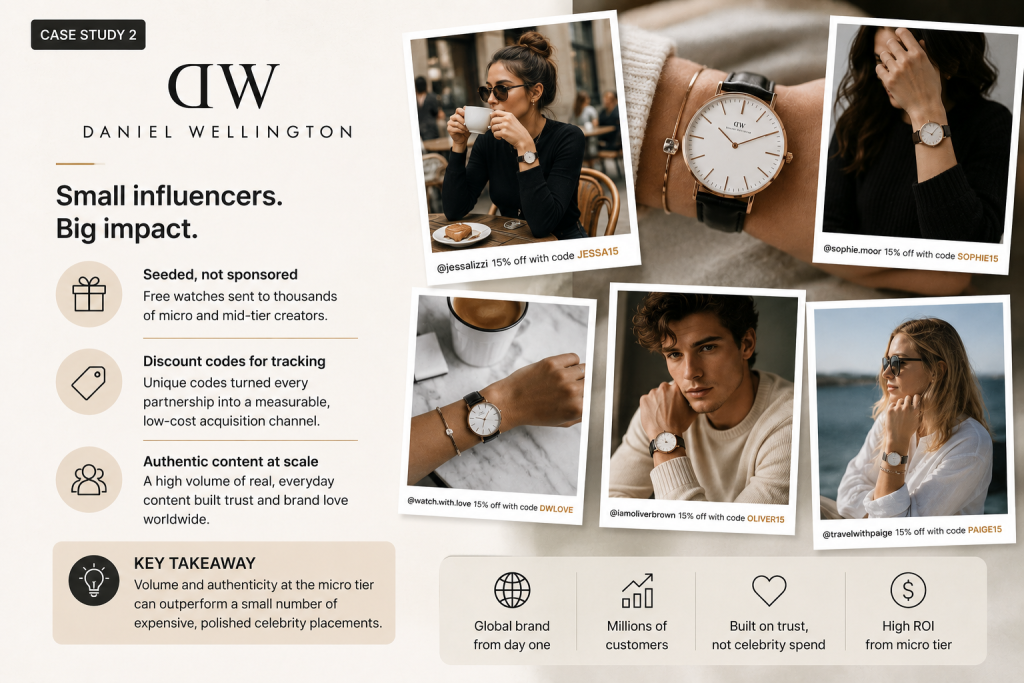
The Swedish watch brand Daniel Wellington is one of the most frequently cited micro-influencer case studies globally. Instead of large ad budgets, the brand seeded free watches to a large number of small and mid-sized Instagram creators, paired with individual discount codes, turning nearly every partnership into a trackable, low-cost acquisition channel.
The sheer volume of authentic, everyday content rather than a handful of expensive celebrity posts is widely credited with helping the brand scale into a globally recognised name from a standing start.
The takeaway: volume and authenticity at the micro tier can outperform a small number of expensive, polished celebrity placements.
Case Study 3: Glossier (Global)
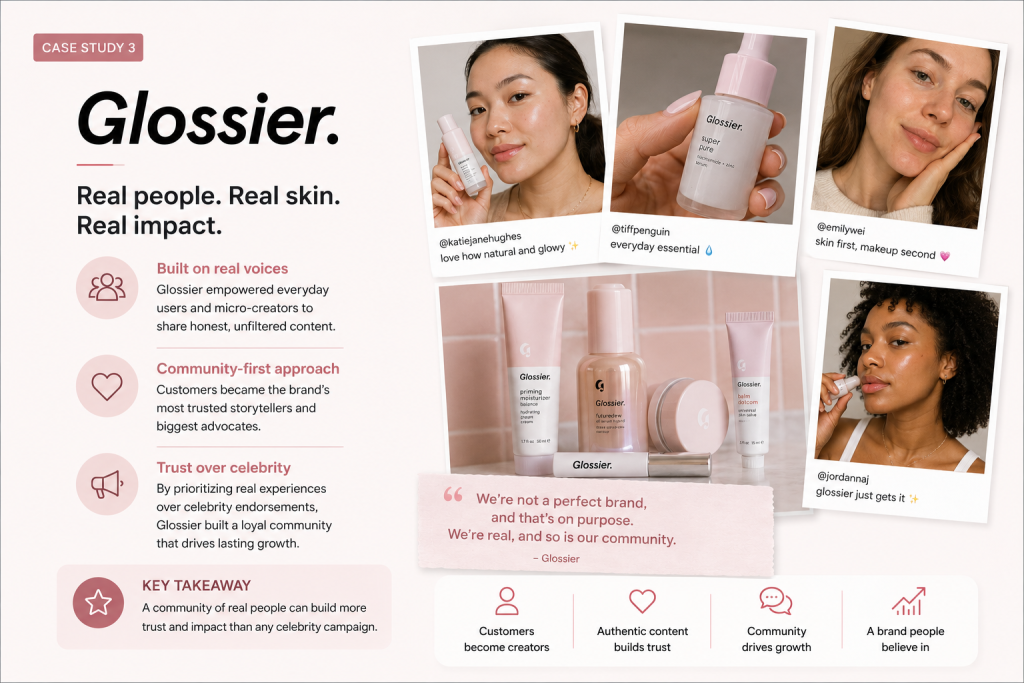
Beauty brand Glossier built its identity almost entirely around real customers and micro-influencers rather than traditional celebrity marketing, encouraging everyday users and smaller creators to share honest, unpolished product content.
This community-first approach turned customers into the brand’s most credible marketing channel and is frequently referenced as one of the clearest examples of a brand built on user and micro-influencer trust rather than paid celebrity reach.
Case Study 4: What We’ve Seen at echoVME
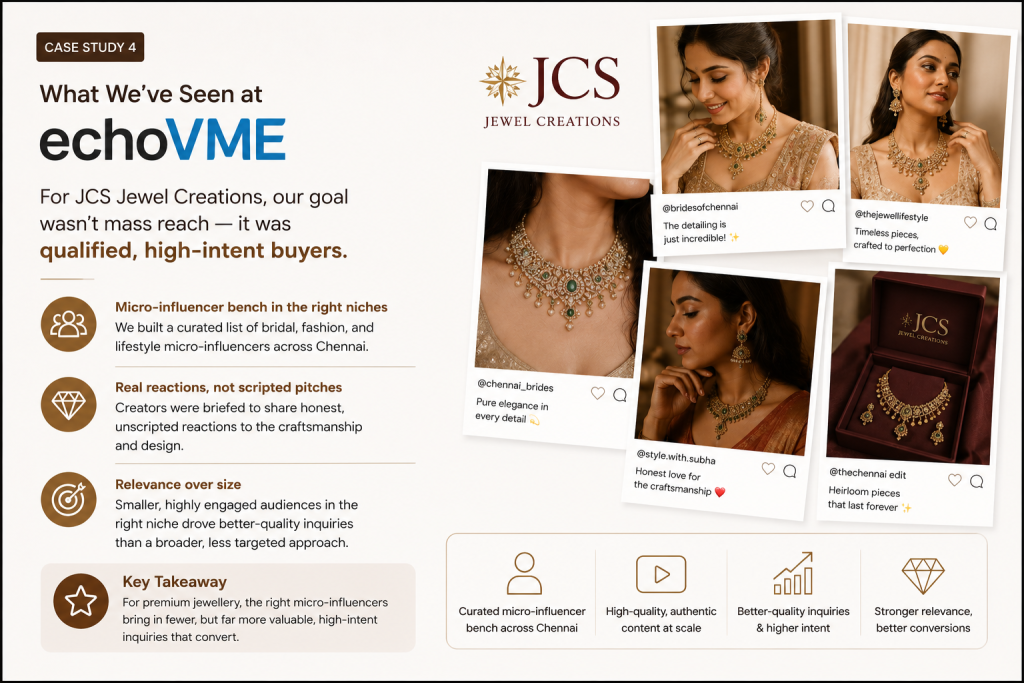
We did this ourselves for a premium jewellery client, JCS Jewel Creations, where the goal wasn’t mass reach but qualified, high-intent buyers. Instead of one celebrity endorsement, our BuzzFame team built a bench of micro-influencers in the bridal, fashion, and lifestyle space across Chennai, briefed to show real, honest reactions to the craftsmanship rather than deliver a scripted pitch. The relevance of the audience mattered far more than the size; a smaller, highly engaged following in the right niche consistently drove better-quality inquiries than a broader, less targeted push would have.
Micro-Influencer Marketing Strategies We Use at echoVME
- Set a clear objective first. We define whether the goal is awareness, community-building, or direct conversions before selecting a single creator this decision changes everything downstream.
- Vet for relevance and authenticity, not just numbers. We screen for genuine audience overlap with the brand’s target customer, real (not purchased) engagement, and content quality, rather than sorting by follower count.
- Build a bench, not a single partnership. A single micro-influencer post rarely moves the needle. We build a bench of 10-20+ relevant creators running in parallel, so the campaign has statistical weight and resilience if a few partnerships underperform.
- Brief lightly, let creators be themselves. We share key messages and mandatory disclosure requirements, but let each creator shoot in their own voice and format this is the single biggest driver of authenticity at this tier.
- Add performance incentives. We increasingly structure micro-influencer deals as a smaller flat fee plus a commission on trackable codes or links, rewarding creators for content and for driving real sales.
- Think long-term, not campaign-by-campaign. We repeat successful partnerships across multiple product cycles instead of running one-off posts, since familiarity compounds trust with a creator’s audience over time.
- Measure weekly, not quarterly. We track engagement rate, saves, and where possible, code-based conversions weekly, and reallocate budget away from underperforming creators quickly.
Where to Find Micro-Influencers: Platforms
“Platforms” here means two different things: the social platforms where micro-influencers actually publish, and the tools brands use to discover and manage them. We use both.
Social platforms
- Instagram: Still the primary home for micro-influencer marketing in India, especially through Reels used by the vast majority of Indian influencers across fashion, beauty, food, and lifestyle niches.
- YouTube (long-form and Shorts): Strong for longer-form reviews, unboxings, and tutorials, and a category where many micro-creators build especially loyal, high-intent subscriber bases.
- LinkedIn: Growing steadily among Indian micro and nano creators for text and short-video-adjacent content, particularly in finance, career, and B2B niches.
Influencer discovery and management platforms
- Influencer marketplaces and discovery tools such as Qoruz, Winkl, and Katha help brands filter creators by engagement rate, audience demographics, and past brand collaborations rather than follower count alone.
- Larger creator relationship platforms like GRIN and Upfluence support end-to-end campaign management, from discovery through contracting, content approval, and payout tracking.
- We also draw on our own BuzzFame creator network, built over years of direct campaign relationships across categories which lets us skip a layer of discovery overhead for clients.
Best Practices for Micro-Influencer Campaigns
- Prioritise fit over follower count. niche relevance and engagement quality predict campaign performance far better than follower count.
- Give creators creative freedom within a light brief. A rigid, ad-style script is the fastest way to make a micro-influencer’s authentic-feeling content look like a paid ad.
- Pilot before scaling. Trial a smaller group of creators before committing a full quarter’s budget to a wider bench.
- Stay compliant. Ensure every sponsored post carries clear disclosure in line with ASCI guidelines.
- Treat creators as partners. Fair, on-time payment and clear expectations lead to better content and repeat collaborations at this tier more than any other.
Common Mistakes to Avoid
- Follower counts can be inflated with bots; always check engagement rate and comment quality before signing a creator.
- Working with a single micro-influencer and expecting macro-level reach misunderstands what this tier is good for.
- Assuming a low-follower creator will accept a low fee regardless of engagement quality pricing should follow performance data, not assumptions.
- One-off micro-influencer posts rarely build the recurring trust that makes this tier valuable in the first place.
This tier-first thinking runs through everything echoVME does. Sorav Jain, our Founder & CEO, has spent 18+ years in digital marketing, growing echoVME from a Chennai-based startup in 2011 into a 150+ member agency serving 300+ brands, and founding Digital Scholar, India’s agency-style digital marketing training institute.
Under his guidance, our BuzzFame division has run 300+ influencer campaigns spanning nano to celebrity tiers, and the pattern we keep coming back to, campaign after campaign, is that a well-chosen bench of micro-influencers usually outperforms a single big name which is exactly why this guide leads with the data and the case studies rather than a sales pitch for celebrity spend.
How to Measure ROI on Micro-Influencer Campaigns
Because micro-influencer campaigns are cheaper per unit but run at higher volume, measurement discipline matters more here than at any other tier a bench of 15 creators without a tracking plan is 15 untraceable line items.
- Attribution: We assign each creator a unique discount code or trackable link wherever the brand has an e-commerce checkout, which lets us tie specific sales directly back to specific creators.
- Engagement quality: Beyond likes, we track saves and shares as stronger signals of genuine interest, since they indicate a viewer valued the content enough to revisit or pass it on.
- Cost efficiency: We measure cost per engagement and cost per acquisition per creator, not just per campaign, so we can see which specific creators are actually earning their fee.
- Brand lift signals: Where a direct sale isn’t trackable, we look at branded search volume and direct traffic upticks in the days following a wave of creator content, since micro-influencer campaigns often show up as assisted conversions rather than last-click ones.
Our rule of thumb: if we can’t tell within two weeks which creators in a bench are actually working, the tracking setup, not the campaign, is the problem, and we fix that before scaling further.
Conclusion
Micro-influencer marketing works because it brings brands closer to the communities they actually want to reach. While bigger creators can deliver scale, micro-influencers often offer something more valuable for growing brands: stronger audience relevance, higher engagement, and content that feels like a genuine recommendation rather than a campaign placement.
The most effective programs are not built around one creator or one post. They combine a carefully selected bench of creators, clear but flexible briefs, reliable tracking, and the willingness to scale what performs.
For D2C, beauty, jewellery, and other high-consideration categories, that balance can turn creator content into a consistent growth channel.
Thinking about building a micro-influencer program that actually moves the needle for your brand? That’s exactly the kind of campaign our BuzzFame team runs every week. Get in touch with us at echoVME to talk through your creator strategy for 2026.
FAQs Related to What Is Micro-Influencer Marketing
What follower count qualifies someone as a micro-influencer?
Micro-influencers typically have between 10,000 and 100,000 followers, sitting above nano-influencers (1,000-10,000) and below macro-influencers (100,000-1 million) on the creator tier spectrum.
Are micro-influencers more effective than celebrities?
For engagement rate and cost efficiency, yes. Micro-influencers average around 3.86% engagement versus 1.21% for mega-influencers, though celebrities still win on sheer awareness reach for mass launches.
How much do micro-influencers charge in India?
Indian micro-influencers typically charge ₹8,000 to ₹80,000 per deliverable in 2026, depending on category, engagement rate, and platform, with beauty and fashion creators generally commanding higher rates.
How many micro-influencers should a brand work with per campaign?
We generally recommend a bench of 10-20+ relevant micro-influencers rather than one or two, since this spreads risk and gives the campaign enough volume to reliably measure performance.
Which platform works best for micro-influencer marketing in India?
Instagram remains the dominant platform for Indian micro-influencer campaigns, particularly through Reels, with YouTube strong for longer-form reviews and LinkedIn emerging for finance and B2B niches.
Can small businesses afford micro-influencer marketing?
Yes. Micro and nano-influencer collaborations are among the most accessible entry points into influencer marketing, often costing a fraction of macro or celebrity partnerships while delivering stronger engagement.
How do you find the right micro-influencers for a brand?
Screen for genuine audience overlap with your target customer, real engagement (not inflated followers), and content quality, using discovery platforms or an agency’s existing creator network.
Should micro-influencer content be scripted?
No. Brief creators on key messages and disclosure requirements, but let them create in their own voice and format over-scripted content undermines the authenticity that makes this tier effective.
What is a well-known example of successful micro-influencer marketing?
Daniel Wellington is one of the most cited global case studies, scaling largely through seeding products to many small and mid-sized creators paired with individual discount codes rather than big-budget celebrity ads.
How does echoVME run micro-influencer campaigns?
Through our BuzzFame division, we define objectives first, vet creators for relevance and authentic engagement, build a bench rather than a single partnership, and measure performance weekly.
